How it Breaks: the kimura
Topic: Jiujitsu
If you follow BJJ at all, I’m sure you’ve already seen the brutal kimura finish from Daniel Deeder at UFC BJJ 11. Deeder snapped the arm of 16-year-old Kolby Gonzalez in the third and final round of the opening match. If you haven’t seen it, here it is…viewer discretion advised:
GRAPHIC Kimura arm break! 😖😖
— Anton Tabuena (@antontabuena) September 25, 2026
Kingsway prospect Daniel Deeder kicked off UFC BJJ 11 with a brutaaaaal kimura finish. pic.twitter.com/HARDsNw1TM
The kimura is a shoulder lock submission that, when applied correctly, places a tremendous amount of torque (or rotational stress) through the shoulder joint. It’s named after Masahiko Kimura, who famously used it to defeat Helio Gracie in 1951 (Kimura used the submission to break Gracie’s arm…twice…after Gracie refused to tap to the first break).
“But if the kimura is a shoulder lock, why does the arm break?”
Let’s start with the basics.
Rotational forces
A rotational force is known in physics as torque. It’s calculated by multiplying the force () by its distance from the pivot (, known as the moment arm) and by the sine of the angle between them ():
You can increase torque by increasing the force applied, lengthening the moment arm, or making the angle of force application more perpendicular to the moment arm.
Think about using a wrench with a long handle. The longer the handle (i.e., the moment arm), the less force you have to apply to achieve the same amount of torque around the bolt. That’s why a longer wrench gives you more mechanical advantage. On the other hand, if you use a shorter wrench, or choke up on the handle of the wrench, you will have to exert more force to achieve higher torque. So, to maximize the mechanical efficiency of the wrench, you apply the force toward the very end of the handle and completely perpendicular to the handle (i.e., at a 90-degree angle).
Now apply this to the kimura. When you attack with a kimura, you’re forcing your opponent’s shoulder to internally rotate, which is rotation about the humerus’s long axis. The torque on the humerus depends on three things: the force you apply at the wrist (), how far your grip is from the axis of rotation (), and the angle between your applied force and the forearm (). Pushing perpendicular to the forearm makes , which gets you the most torque from your force. The elbow angle matters because it sets . The distance from the humerus’s axis to the wrist is:
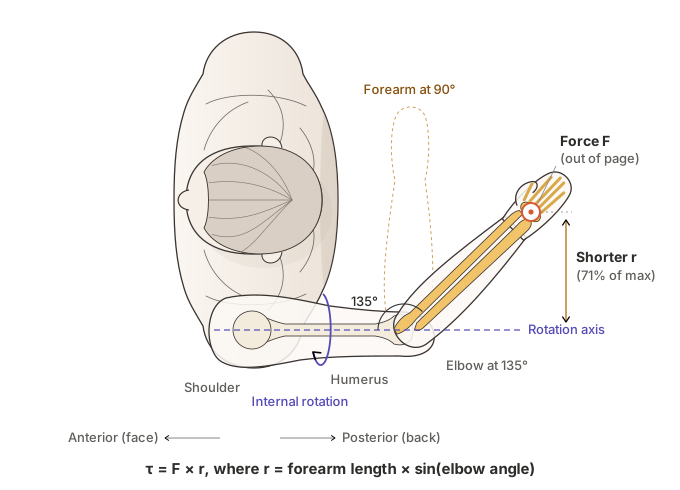
At 90°, equals the full forearm length. As the arm straightens, shrinks toward zero and reduces torque.
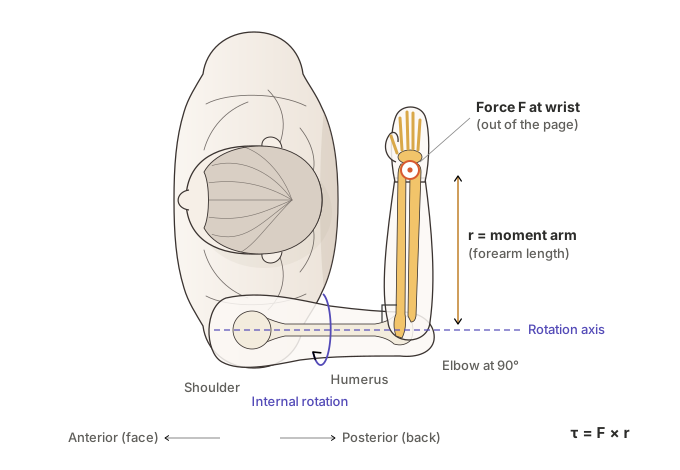
If you’re attacking with a kimura, you can use the same principles discussed with the wrench to optimize the mechanical efficiency of your attack. Specifically, maximize your moment arm by gripping your opponent’s wrist and keeping their elbow at a 90-degree angle (both of these ensure that your force is being applied further away from the axis of rotation, therefore producing the highest possible torque).
On the flip side, if you’re trying to escape the kimura, think about your options. You don’t have much control over the amount of force your opponent is able to apply - this is largely determined by their strength and motivation. So, aside from force, what else can you do to lower torque? You can try to reduce the moment arm. You won’t be able to magically shorten the length of your forearm, but you can change the angle of your elbow so that your wrist - and therefore the attacker’s grip and point of force application - is closer to the axis of rotation. Assuming the attacker keeps force constant, shortening their moment arm will reduce torque. In the diagram below, the elbow is extended beyond 90-degrees (i.e., the arm is straighter), reducing the moment arm and therefore the torque of the kimura.
Of course, as is often the case in jiujitsu, the best defense against the kimura is to not get caught in one in the first place. While straightening your arm in a kimura may reduce the torque of that attack, it leaves you susceptible to other attacks, particularly straight arm locks (we’ll cover how those break your arm in a future post).
How it breaks
So, how does the kimura break the arm?
As the kimura pushes the shoulder into internal rotation, the soft tissues of the joint (e.g., labrum, ligaments, rotator cuff muscles, etc.) come under tension. Up to a point, the shoulder yields by rotating. Once it reaches the upper limit of its range of motion, the joint stops rotating, and the torque begins to build up in the tissues that make up the joint itself. While the soft tissues of the joint can stretch and absorb some of that load, the humerus is less forgiving. Bone is rigid; it barely deforms before it fails, so if the torque exceeds what the bone can take, it can snap suddenly. That’s not to say that the soft tissues of the shoulder aren’t damaged during a kimura attack. Strained and torn rotator cuff muscles, labrum tears, and AC (acromioclavicular) joint dislocations are all possible injuries resulting from the kimura. And that’s just the shoulder - injuries to the elbow and forearm can also result from the kimura.
But for now, we’ll stay focused on the humerus. The break that most typically occurs when long bones undergo high rotational forces is called a spiral fracture. It’s distinct from other fracture types in that the break line curls around the shaft of the bone like a corkscrew, often leaving behind jagged edges and bone fragments. This makes the repair and recovery more difficult than simpler transverse or linear fractures. Not only is it more difficult to re-align the bone segments after the fracture, but the jagged edges left behind can damage soft tissues, blood vessels, and nerves in the arm. Of particular concern is the radial nerve, which runs along the humerus and can easily be damaged during a spiral fracture. Some reports estimate that ~15% of humerus spiral fractures are associated with radial nerve palsy.
The extent of Gonzalez’s injury is still unknown, but a typical spiral fracture takes 6-12 weeks for the initial bone recovery to occur and another 9 months for full functional recovery to occur. Fortunately, Gonzalez is young and healthy, so I’m hoping his recovery is smoother and faster than average.
Sometimes you just gotta tap
So there you have it. The kimura is a rotational attack on the shoulder that often has devastating consequences for the upper arm. If your goal is to stay on the mats for the next 6-12 months, I’d recommend tapping if you get caught in one as deep as we saw at UFC BJJ 11. Just my two cents.

Delusional optimist. Biomechanics and Motor Control researcher. Data science and analytics by day, hacker by night; created Crowd Card and Refology. Contributing developer to Silk Pyjamas and The Work App.